
The One Conversation Most Leaders Are Avoiding
Trust grows through honest conversation. Three questions can help leaders understand where they are earning it and where they are falling short.
Opening note
Welcome back to The Culture Shift.
Last week we talked about organizational health and why it starts with a question most leaders are not willing to ask.
This week I want to talk about a conversation.
Specifically the one most leaders are avoiding.
This week
There is a conversation that needs to happen in almost every organization I walk into.
Not about strategy. Not about performance. Not about the next quarter or the next hire.
It is the conversation about trust.
Not in a vague, aspirational sense. But specifically and honestly. Do the people inside this organization actually trust their leaders? And do the leaders actually know the answer?
Most do not. Because most have never asked.
And the reason most leaders have never asked is the same reason most avoid this conversation entirely. They are afraid of what they might hear.
Why This Conversation Gets Skipped
Leaders avoid the trust conversation for three reasons that almost never get named out loud.
The first is vulnerability. Asking your team whether they trust you requires a level of openness that professional culture has historically discouraged. We are trained to project confidence and certainty. Asking "do you trust me" feels like the opposite of that.
The second is accountability. If the answer is no, or not fully, or in some areas more than others, then something has to change. And change is uncomfortable, especially when it means examining your own behavior.
The third is fear of the answer being used against you. In organizations where psychological safety is low, leaders worry that opening this conversation signals weakness rather than strength.
So the conversation does not happen. And trust erodes slowly and quietly until the day someone good leaves, or something breaks, or the culture survey results come back and everyone pretends to be surprised.
What the Conversation Actually Looks Like
The trust conversation does not have to be a formal process or a structured initiative. In fact the most powerful versions I have seen have been simple and direct.
It looks like a leader sitting down with their team and saying: I want to understand where I am earning your trust and where I might be falling short. I am asking because I genuinely want to lead better and I cannot do that without knowing the truth.
That sentence takes about fifteen seconds to say. And in organizations where it has never been said, it changes everything about the room.
It gives people permission to be honest. It signals that the leader sees themselves as accountable to the same standards they hold others to. And it opens the door to the kind of genuine conversation that every high-performing team is having and most struggling teams are not.
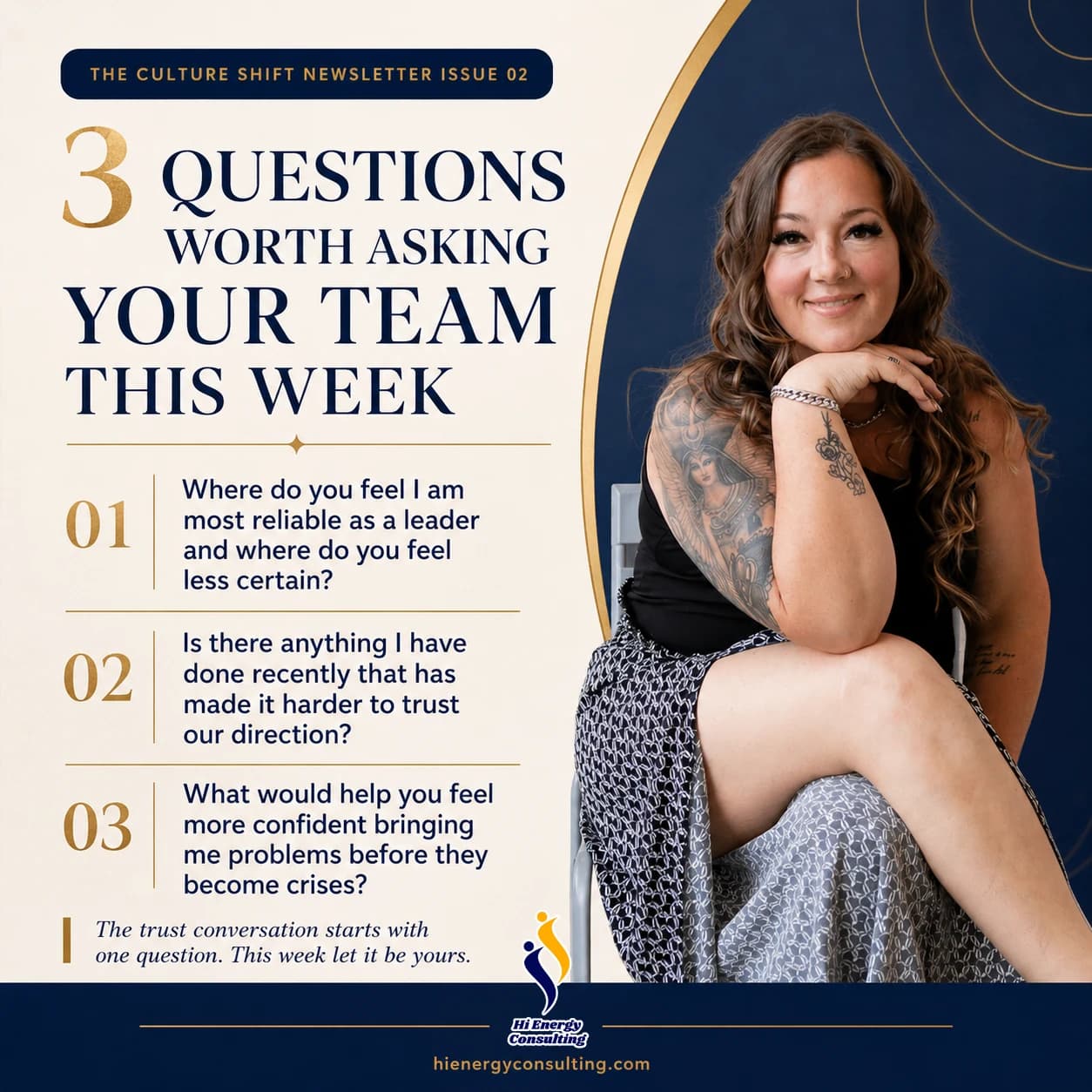
Three Questions Worth Asking Your Team This Week
You do not need a framework or a consultant to start this conversation. You need three questions and the courage to sit with the answers.
One. Where do you feel I am most reliable as a leader and where do you feel less certain about what to expect from me?
Two. Is there anything I have done or not done recently that has made it harder for you to trust the direction we are heading?
Three. What would help you feel more confident in bringing me problems before they become crises?
These questions are not easy to ask. But they are far less expensive than the cost of not asking them.
The Business Case for Trust
High-trust organizations make decisions faster. They retain talent longer. They surface problems earlier. They adapt to change more effectively. They execute with more clarity and less internal friction.
None of that is coincidental. It is the direct output of leaders who chose to build trust intentionally rather than hope it would develop on its own.
That is the work I do at HiEnergy Consulting. And it is some of the most important work any organization can invest in.
If the trust conversation is one you have been avoiding, I would love to talk about what it would look like to have it.
Kaleigh Williams
President and CEO, HiEnergy Consulting. HR strategist and organizational development consultant.