
The Most Expensive Decision a Leader Makes
Who you bring onto the team shapes everything else. Why hiring goes wrong, what it really costs, and how to build a more thoughtful selection process.
Opening note
Welcome back to The Culture Shift.
Over the last two issues we have talked about organizational health and the trust conversation most leaders avoid. This week I want to talk about a single decision. One that shapes culture more than almost any other and gets far less attention than it deserves.
Who you allow onto the team.
This week
There is a decision leaders make a handful of times a year that quietly shapes everything else.
Not the strategy. Not the budget. Not the quarterly plan.
Who they choose to bring onto the team.
I have spent years working inside organizations watching the downstream effects of this one decision, and I have become convinced that talent selection is the single most underestimated lever a leader has. We treat it as a box to check, a task to delegate, a process to get through so we can get back to the real work.
But selection is the real work. Because every person you bring onto a team either raises the standard or quietly lowers it. There is rarely a neutral hire.
Why We Get It Wrong
The uncomfortable truth is that most bad hires are not the result of bad people or careless leaders. They are the result of good leaders trusting the wrong things under pressure.
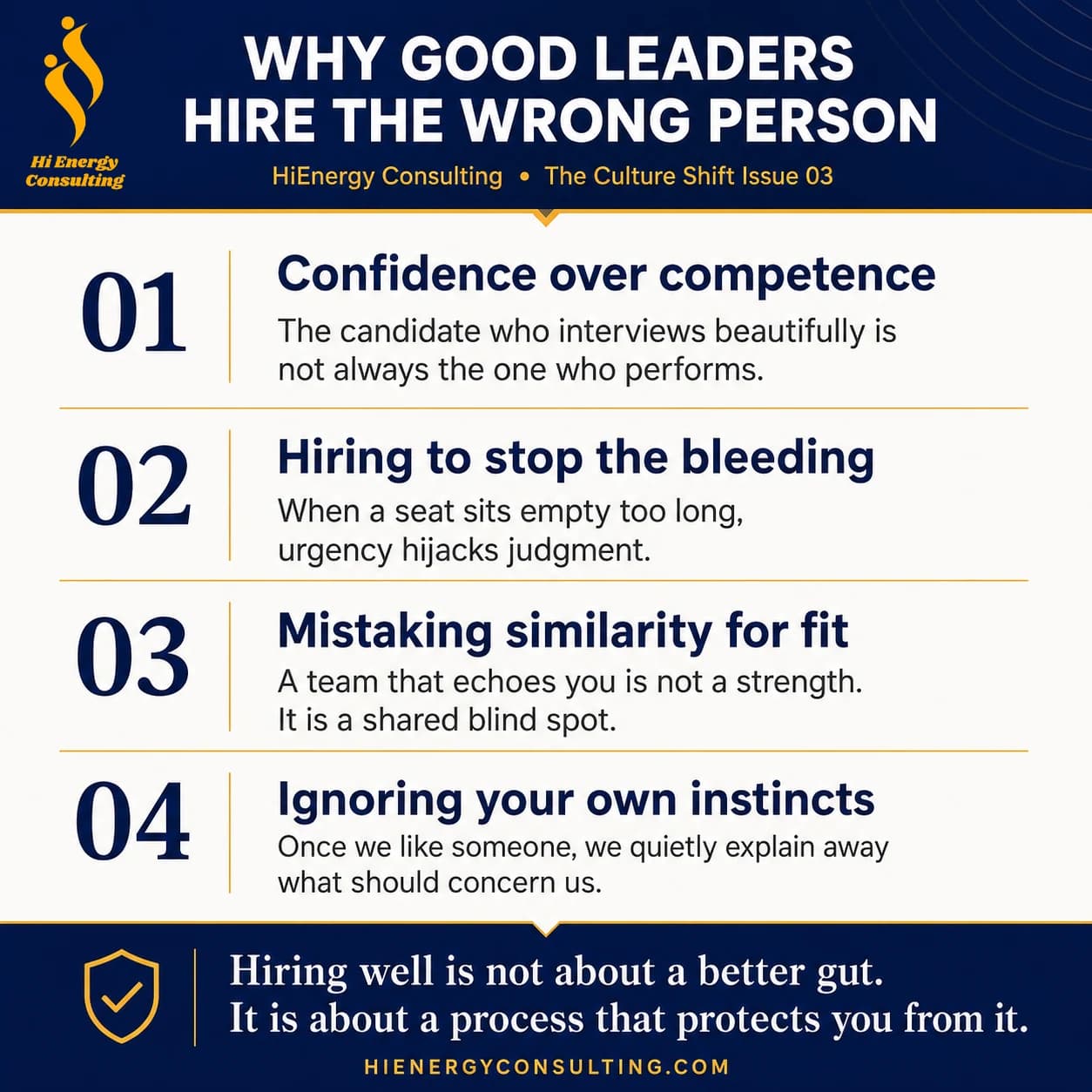
We confuse confidence with competence. The candidate who interviews beautifully is not always the one who performs. Interviews reward a very specific skill, the ability to talk about work, which is not the same as the ability to do it.
We hire to stop the bleeding. When a role has been empty too long and a team is stretched thin, urgency hijacks judgment. We stop asking who is right and start asking who is available. A seat filled by the wrong person is more expensive than a seat left open, but it rarely feels that way in the moment.
We mistake similarity for fit. It is easy to feel a connection with someone who reminds us of ourselves. But cultural fit is not about sameness. The strongest teams are built from people who complement each other, not people who echo each other.
And perhaps most damaging of all, we ignore our own instincts. Once we have decided we like someone, we quietly explain away the things that should concern us. The reference who was lukewarm. The story that did not fully add up. The value that seemed slightly misaligned. We override the small voice because we want the search to be finished.
What a Wrong Hire Actually Costs
When leaders calculate the cost of a bad hire they look at salary, recruiting fees, and lost time. Those numbers are real, but they are the smallest part of the bill.
The true cost is cultural.
A wrong hire changes the behavior of everyone around them. Your strongest people begin compensating, absorbing the work that is not getting done. Resentment builds quietly. The team learns that the standard is negotiable, because they can see someone falling short of it without consequence. The leader, instead of developing the whole team, becomes consumed managing one person.
And the most expensive cost of all is the one you never see on a spreadsheet. It is the good people who decide, often silently, that this is not the kind of team they want to be part of anymore. By the time a leader is ready to admit the hire was a mistake, some of the best people have already started to leave.
Getting Selection Right
Hiring well is not about having a better gut. It is about building a process that protects you from your own instincts.
It means getting clear on the one or two capabilities that genuinely matter for the role before you ever meet a candidate, rather than being swayed by a long list of nice to haves in the moment.
It means involving more than one perspective, because the blind spots of a single decision maker are far more dangerous than the blind spots of a thoughtful group.
It means treating references and patterns as data worth taking seriously rather than formalities to rush through.
And it means having the discipline to leave a seat empty rather than fill it with the wrong person. That discipline is rare, and it is one of the clearest signs of a leader who understands what is truly at stake.
Why This Matters
You cannot build a healthy culture on the wrong people, no matter how strong your values or how clear your vision. Culture is not built in the mission statement. It is built in who you allow to stay in the room.
The leaders who understand this treat selection with the seriousness it deserves. Not as a task to delegate, but as one of the most important forms of leadership they practice all year.
That is the work I do at HiEnergy Consulting. Helping leaders and organizations build the systems, the clarity, and the discipline to get their most important people decisions right.
If selection is something you are navigating inside your organization right now, I would genuinely love to have that conversation.

Kaleigh Williams
President and CEO, HiEnergy Consulting. HR strategist and organizational development consultant.