
Why Organizational Health Starts with a Question Nobody Wants to Ask
People and systems are deeply connected. A practical look at whether your organization is designed to produce the outcomes you want.
Opening note
Welcome to The Culture Shift.
I have been writing and speaking about leadership, culture, and people strategy for years. And the question I get most often is not about strategy or frameworks or best practices.
It is a much simpler and more honest question: why does this feel so hard?
Why does culture change feel impossible even when everyone agrees it is needed? Why do the best leaders still struggle with feedback? Why do organizations keep losing good people and never quite understand why?
The Culture Shift exists to answer those questions in real, honest, practical terms. Not with buzzwords or theory. With the kind of straight talk that comes from years of sitting inside organizations and watching what actually works and what does not.
Every week I will share one idea, one insight, or one honest observation about the human side of building better organizations.
If that is useful to you, I am glad you are here.
This week
There is a question I ask every organization I work with before we do anything else.
Not about their strategy. Not about their structure. Not about their culture survey results or their engagement scores.
The question is simpler and more uncomfortable than any of those.
Is your organization actually designed to produce the outcomes you say you want?
Most leaders pause when they hear that. Because when they sit with it honestly the answer is often no.
Not because anyone made bad decisions. But because organizations evolve faster than the systems designed to run them. The reporting structure that made perfect sense when there were twelve people creates confusion and disengagement at one hundred and fifty. The decision-making process that worked when the founder was involved in everything becomes a bottleneck when that same founder is trying to lead at scale.
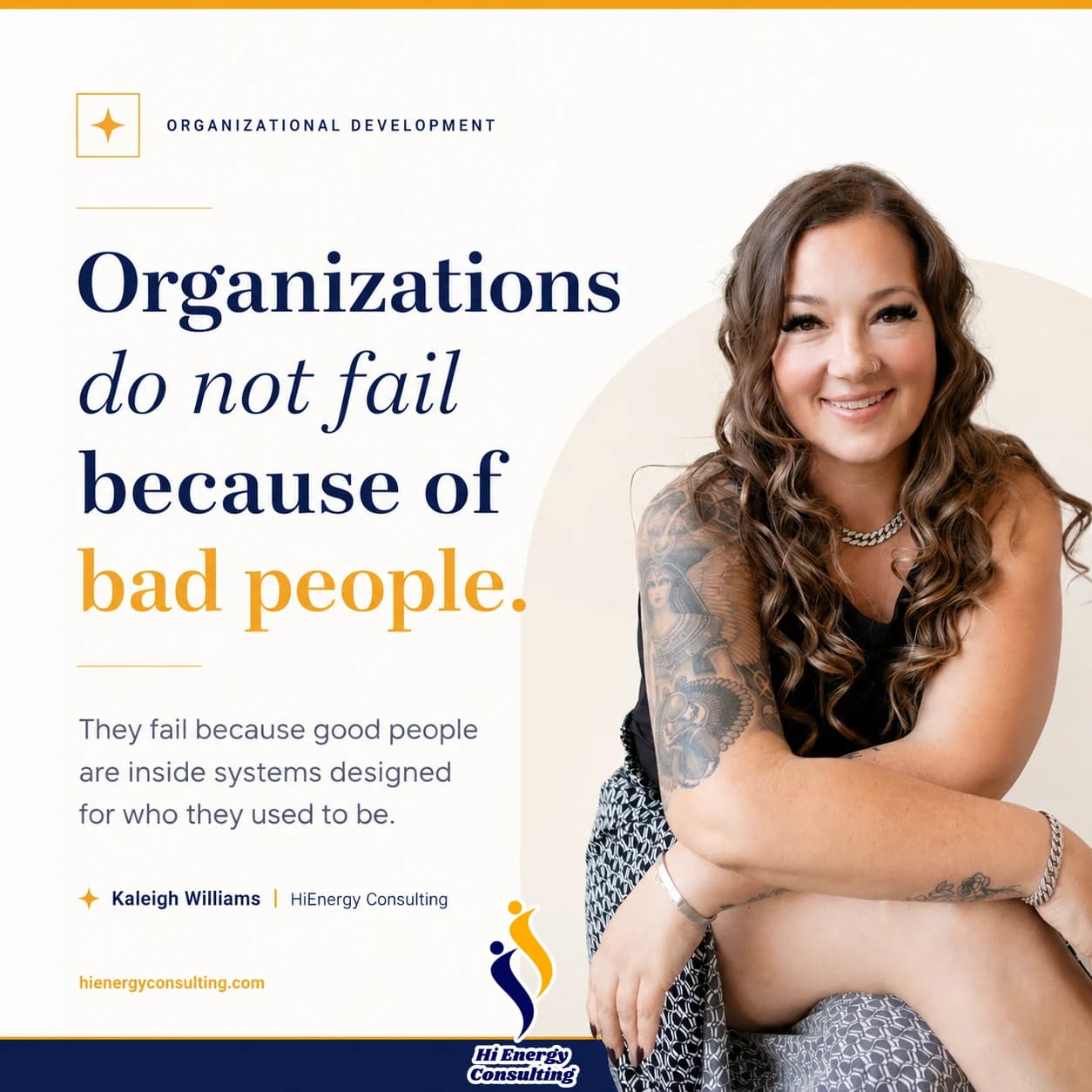
Organizations do not fail because of bad people. They fail because good people are operating inside systems that were designed for a version of the organization that no longer exists.
The Difference Between HR Strategy and Organizational Development
I work at the intersection of two disciplines that are often treated as separate and that are actually deeply connected.
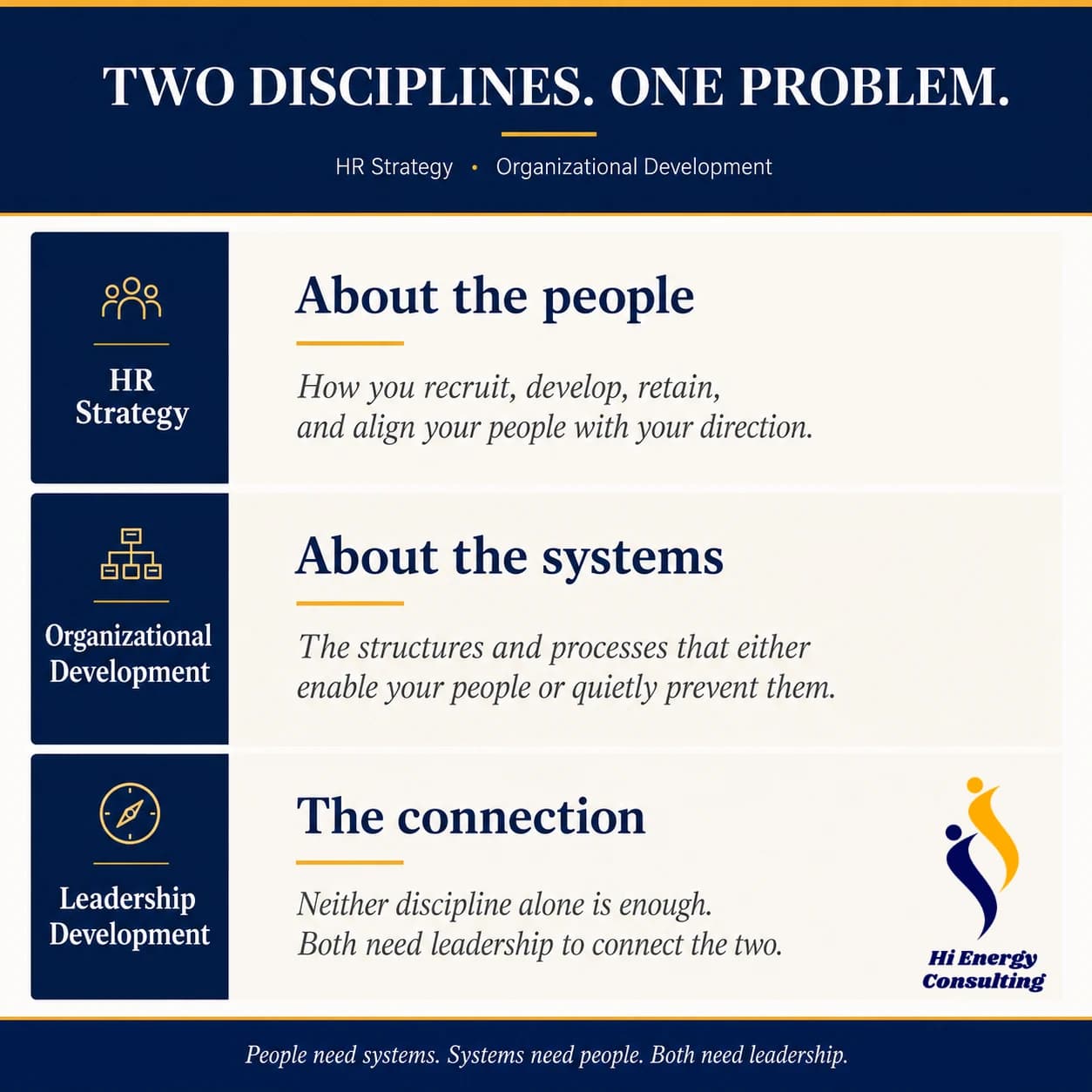
HR strategy is about the people. How you recruit them, develop them, retain them, and ensure that the people side of your business is aligned with your overall direction.
Organizational development is about the systems. The structures, processes, cultures, and leadership behaviors that either enable your people to do their best work or quietly prevent them from doing so.
Both matter. Neither is enough on its own.
I have seen organizations with excellent HR practices struggle because their systems were fundamentally broken. And I have seen organizations with clean, efficient systems struggle because nobody invested in developing the human capability inside those systems.
The organizations that actually thrive over time are the ones that understand that people and systems are not separate problems to be solved by separate departments. They are one problem that requires one integrated approach.
What This Looks Like in Practice
Organizational health work starts with observation and honest inquiry. Not surveys that produce data nobody acts on, but real conversations at multiple levels of the organization about what is actually happening versus what leadership believes is happening.
The gap between those two things is almost always where the most important work lives.
It looks like a leader who is willing to ask whether their decision-making process is designed to build their team's capability or to protect their own sense of control.
It looks like an organization that treats a performance issue as a systems question before it is a people question. Not to excuse poor performance but to ensure the environment in which performance is expected has been designed to enable it.
It looks like an HR function that is not just reactive to problems but proactive in designing the conditions that prevent them.
Why This Matters Right Now
The pace of change in organizations today is faster than most structures were designed to absorb. The leaders who understand this and are willing to examine their systems with the same rigor they apply to their strategy will be the ones who build organizations that can sustain growth without burning out their people in the process.
That is the work I do at HiEnergy Consulting. And it is the most important work I know.
If any of this resonates with something you are navigating inside your organization right now I would genuinely love to have a conversation.
Kaleigh Williams
President and CEO, HiEnergy Consulting. HR strategist and organizational development consultant.