
Why Your Best People Stop Growing
No stretch. No feedback. No belief. Recognize the quiet signs of stalled growth and turn development into a weekly leadership practice.
Opening note
Welcome back to The Culture Shift.
Last issue we talked about what makes a team worth belonging to. This week I want to talk about what happens after people belong. Because there is a quiet thing that happens to good people on good teams, and almost nobody notices it while it is happening, including them.
They stop growing.
This week
Nobody announces it. There is no meeting where a talented person declares they have stopped developing. Performance usually stays perfectly fine, which is exactly what makes it invisible.
But the signals are there if you know where to look. The questions slow down. The ideas start sounding like last year's ideas. The extra effort quietly fades, not into laziness, but into a kind of careful efficiency. The pushback disappears. And in one on ones, they start talking about what was instead of what is next.
By the time it becomes visible, one of two things is already underway. Either your best person is growing again somewhere else in their imagination, updating a resume you will not see until it is too late. Or, and this one is more expensive, they stay, and they shrink to fit the size of the role they have been left in. The second one is worse because it looks like retention.
It counts as a win on the turnover report while the organization quietly loses everything that person was capable of becoming.
Why It Happens
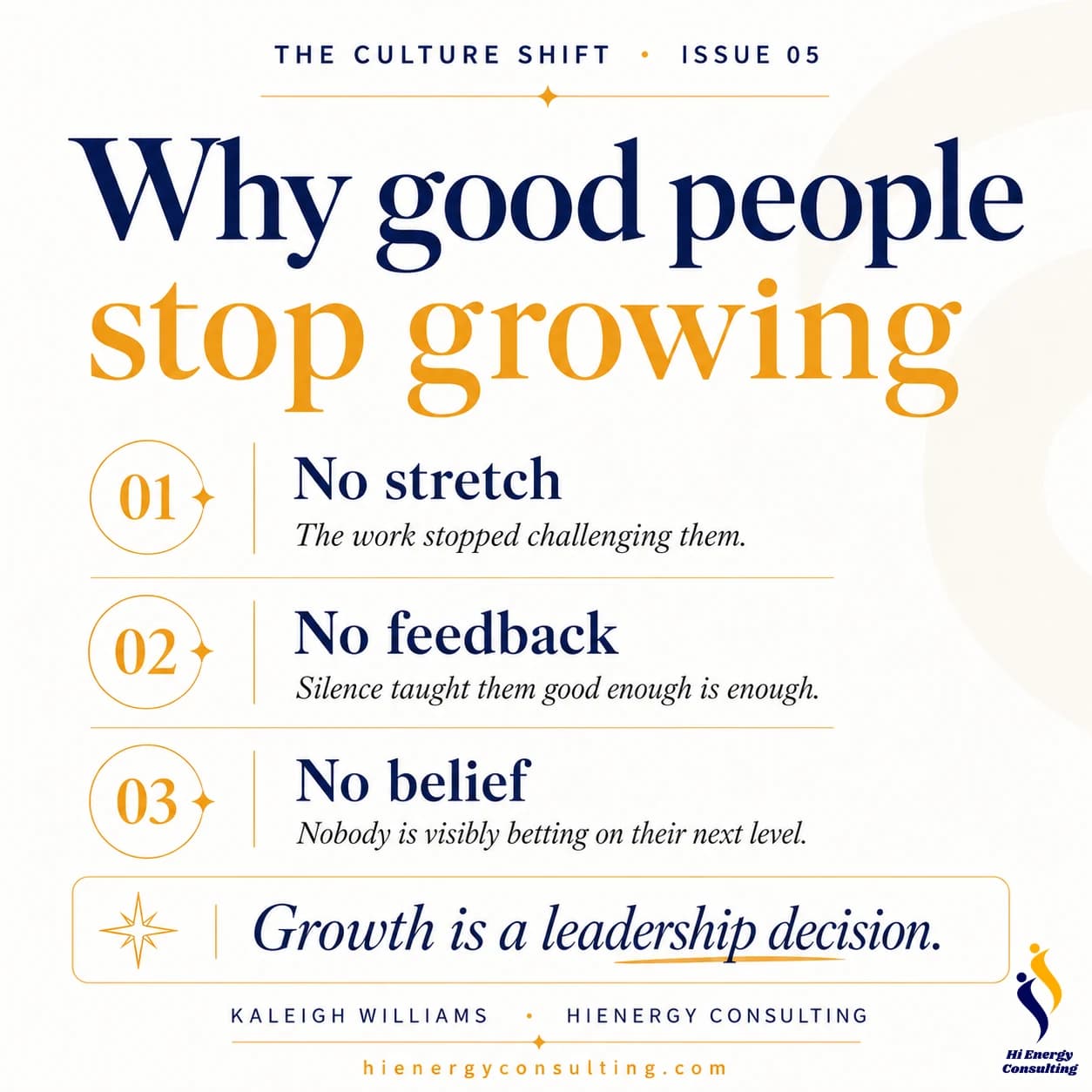
In my experience it almost never comes from neglectful leaders. It comes from three quiet absences.
No stretch. The work stopped challenging them, usually because they got good at it, and being good at something is exactly when most leaders stop handing people anything new. Competence gets rewarded with more of the same.
No feedback. Not the absence of criticism, the absence of investment. When the only feedback someone receives is silence punctuated by an annual review, the silence teaches them that good enough is enough. Growing people need to hear what they are becoming, not just what they did.
No belief. This is the one leaders underestimate most. People grow toward the vision someone holds for them. When nobody is visibly betting on their next level, saying their name in rooms they are not in, telling them plainly what they are capable of, most people quietly stop betting on themselves.
What Growing People Actually Looks Like
It is not a program. It is not a training budget, although those help. It is a set of leadership behaviors practiced weekly.
It looks like handing someone work slightly bigger than anything they have done, and staying close enough that the stretch builds them instead of breaking them. It looks like feedback given while the work is still in motion, when it can still shape something. It looks like sponsorship, which is different from support. Support is encouraging someone in private. Sponsorship is advocating for them in public, in the rooms where their future actually gets decided.
And it looks like a leader asking one question in every one on one that most leaders never ask. What do you want to be ready for next?
Why This Matters
You chose your people carefully. You built a team they belong to. Growth is the third act, and it is the one that decides whether the first two were an investment or just an expense. Because talented people do not stay where they stop growing. And the ones who do stay stop being the people you hired.
This is the work I do at HiEnergy Consulting. Helping leaders turn growth from a yearly program into a weekly practice, so their best people keep becoming more, right where they are.
This month I am opening a small number of complimentary leadership conversations. Thirty minutes, no pitch, just an honest look at how you are growing the people you lead and where the next level might be hiding. You can book your time directly here: Book a conversation.
P.S. If one person on your team came to mind while you were reading this, that is usually the sign it is time for the conversation. Grab a time here: Book a conversation.

Kaleigh Williams
President and CEO, HiEnergy Consulting. HR strategist and organizational development consultant.